Industrial 3D Printer Buyers Guide
Over 77% of printers marketed for high performance polymers can’t reliably print PEEK or ULTEM. Make your next investment with confidence, not consequences.

Polyether-ether-ketone (PEEK) is a high-performance thermoplastic in the polyaryletherketone (PAEK) family. It was designed specifically for demanding applications when other materials proved inadequate.
PEEK material exhibits outstanding performance under harsh conditions as it is inherently strong, lightweight, and chemical-resistant. It also comes with high thermal and dimensional stability as well as resistance to hydrolysis. This allows PEEK to be used for critical parts in several fields, e.g., aerospace and biomedical applications.
Let’s take a closer look at PEEK material properties and what these qualities enable from an applications point of view.
What is PEEK?
PEEK thermoplastic combines the excellent mechanical properties of metals and the light weight of plastics, with outstanding chemical and thermal stability.
PEEK was introduced when traditional materials couldn’t keep up with the accelerating advancements in engineering and biomedical applications. For example, some biomedical applications, such as orthopedic implants, require biocompatibility, high mechanical strength, excellent wear and corrosion resistance, and radiopacity. Metals can fulfill some of these requirements, but not all, which reduces implant longevity.
PEEK plastic was designed at the molecular level to replace metals in demanding biomedical and engineering applications. It has a backbone of aromatic rings that gives it heat resistance and mechanical strength, ether links that enhance the flexibility of the structure, and ketone groups for chemical stability.
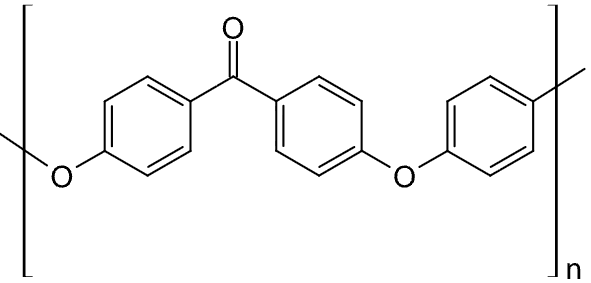
PEEK Material Structure
| Structural Region | Properties Enabled |
| Crystalline Regions (25%-40%) | – Strength and stiffness – Heat resistance – Chemical resistance |
| Amorphous Regions (60%-75%) | – Toughness and impact resistance – Deformation resistance |
PEEK polymer is a semicrystalline solid. It contains crystalline regions with ordered, packed molecular chains and amorphous regions with random, loose molecular chains.
The ordered structure provides tight molecular packing in the crystalline regions, increasing the strength and stiffness of the polymer. This dense structure is also less permeable to chemicals as the molecules are hard to penetrate when closely packed. The ordered chains of PEEK resist motion when subjected to heat and provide dimensional stability.
The amorphous regions provide PEEK plastics with thermoplasticity. Moreover, the disordered chains in the amorphous regions allow motion and stress dissipation, increasing ductility and toughness and preventing brittle fracture. This chain flexibility also enables the absorption of shock energy, enhancing impact resistance.
PEEK Material Properties
The use-cases and applications of PEEK all derive directly from the material’s properties. So a thorough understanding of the properties enables engineers to pick and choose the spots that warrant and require the use of PEEK over other materials.
The properties are grouped as follows – mechanical and physical, thermal, chemical, electrical and lastly a few various qualities packed together.
PEEK Physical and Mechanical Properties
| Property | Typical value/Rating |
| Density | 1.26 – 1.32 g/cm³ |
| Tensile Strength | 85-100 MPa |
| Flexural Strength | 100-170 MPa |
| Impact Strength | 3-8.5 kJ/m² |
| Young’s Modulus | 2.8-3.9 GPa |
| Flexural Modulus | 3.7-4.2 GPa |
| Hardness | 80-100 (Rockwell M) |
| Elongation at Break | 25%-40% |
| Creep Resistance | low creep rate at high temperatures |
| Fatigue Strength | 30-100 MPa @10⁶ cycles |
| Coefficient of Friction | 0.35-0.45 |
PEEK offers exceptional mechanical properties. It has a considerably lighter weight compared to metals of the same volume. For example, it is two times lighter than aluminum.
Strength and toughness
Although the tensile strength and impact strength of PEEK plastic are lower than those of metals (tensile strength of PEEK: 85-100 MPa vs stainless 304: 517 MPa), its impressive strength-to-weight ratio gives it a strong advantage in weight-critical applications. PEEK also offers a flexural strength that is comparable to some metals such as aluminum.
Stiffness
PEEK has reasonable values of Young’s Modulus and Flexural Modulus. Its stiffness is lower than that of metals (Young’s Modulus of PEEK: 2.8-3.9 GPa, stainless 304: 200 GPa), but this can be advantageous in applications that require a balance between stiffness and flexibility such as dental and orthopedic implants.
Hardness and deformation
PEEK’s Rockwell M hardness of 80-100 is above most engineering polymers like nylon (60-75) and comparable to acetal. Its creep resistance sets it further apart. At 100°C under sustained load, nylon and POM deform noticeably within hours, while PEEK maintains dimensional stability, making it suitable for parts like downhole seals or bracket clips under constant stress at high temperatures.
The elongation at break of 25-40% means PEEK is not brittle. It deforms before fracturing, unlike PPS (1-3% elongation) which tends to crack suddenly.
Cyclic loading performance
PEEK’s fatigue strength of 30-100 MPa at 10⁶ cycles (depending on grade and filler) makes it a practical choice for parts under repeated stress, such as spinal fusion cages or pump impellers in chemical plants, where lower fatigue strength would mean premature cracking.
Wear resistance
PEEK’s coefficient of friction of 0.35-0.45 is moderate compared to, for example, PTFE (0.05-0.10), but PEEK’s wear resistance is what sets it apart. This balance of reasonable friction and strong wear resistance is why PEEK works well in bushings, piston rings, and thrust washers.
Carbon fibre-filled PEEK reduces wear rates by roughly an order of magnitude, which is why it shows up in dry-running compressor parts and semiconductor handling equipment where lubricants are not an option.
PEEK Thermal Properties
| Property | Typical value |
| Glass Transition Temperature (Tg) | 143 °C |
| Melting temperature (Tm) | 343 °C |
| Heat Deflection Temperature (HDT) | ~152-160 °C @ 1.8 MPa |
| Operation Temperature Range | -54 to 260 °C |
| Thermal Conductivity | 0.24-0.26 W/m.K |
| Coefficient of Linear Thermal Expansion (CLTE) | 45–55 × 10⁻⁶ /°C |
PEEK’s glass transition temperature of 143°C and melting point of 343°C allow it to operate continuously at up to 260°C, which is well above most engineering polymers. Nylon tops out at around 80-120°C and POM at about 100°C. The lower end of PEEK’s operating range extends to -54°C without significant embrittlement.
Its low thermal conductivity (0.24-0.26 W/m.K) also makes it a good insulator. This is why PEEK is used for sensor housings and protective covers in high-temperature industrial environments where heat-sensitive electronics need shielding.
PEEK Chemical Properties
| Property | Rating |
| Solubility in Different Solvents | Inert to nearly all solvents, acids, and hydrocarbons, except concentrated sulfuric acid |
| Oxidation Resistance | High resistance at elevated temperatures |
| Flammability UL94 (thickness = 1.5 mm) | V0 (self-extinguishing) |
| Limiting Oxygen Index (LOI) | 35% |
| Moisture absorption | about 0.2% |
PEEK’s chemical and hydrolysis resistance and low flammability are among its most advantageous properties.
Hydrolysis resistance
PEEK absorbs very little moisture (about 0.2%), which means its mechanical properties and dimensions stay stable in wet or humid conditions. This makes PEEK a reliable choice for parts exposed to steam, hot water, or high-humidity environments such as food processing equipment or autoclave-sterilised medical instruments.
Chemical resistance
PEEK is inert to nearly all common solvents, acids, and hydrocarbons. Concentrated sulphuric acid is one of the few chemicals that attacks it. In practice, this means PEEK seals and gaskets hold up in chemical processing lines and oil and gas applications where parts are in constant contact with aggressive fluids that would degrade most other polymers.
Flammability
PEEK self-extinguishes when the flame source is removed (UL94 V-0 rating) and produces very little smoke or toxic gas when it does burn. Its limiting oxygen index of 35% is well above the 21% oxygen concentration in normal air, meaning it will not sustain combustion under standard atmospheric conditions. This is a key reason it is used in aircraft cabin components and electrical housings where fire safety requirements are strict.
PEEK Electrical Properties
| Property | Typical value |
| Dielectric Constant | 3.1-3.3 |
| Dielectric Strength | 18-22 kV/mm (High electrical insulation) |
PEEK’s dielectric strength of 18-22 kV/mm and stable dielectric constant of 3.1-3.3 hold steady across its full operating temperature range. This consistency is what sets it apart from many other polymer insulators whose electrical properties degrade as temperatures rise.
Other Qualities
Radiation resistance
PEEK maintains its mechanical integrity and stability under high levels of radiation because of its high resistance to gamma and e-beam radiation. PEEK is also radiolucent, i.e., allowing X-ray to pass with minimal absorption and appearing dark in X-ray images.
Biocompatibility
Medical and food grade PEEK is biocompatible and FDA-compliant (USP Class VI ). It is used for medical implants as well as in food and pharma applications, e.g., high impact machine parts such as conveyors, rollers, scrapers, wear strips, and guide rails.
Dimensional stability
PEEK’s low moisture absorption, low thermal expansion, and creep resistance combine to keep part dimensions stable across changing conditions.
PEEK Material Applications
PEEK’s combination of mechanical strength, chemical inertness, thermal stability, and biocompatibility makes it useful across a wide range of industries. The specific property driving its adoption varies by application.
Biomedical
PEEK biocompatibility and excellent properties make it an ideal material for biomedical applications.
Orthopedic implants
PEEK strength-to-weight ratio, radiolucency, and wear resistance make it an ideal alternative to metals in load bearing orthopedic implants. The performance of PEEK implants is even better than metal implants because PEEK exhibits less stress shielding compared to metals.
The high stiffness of metal implants increases their stress absorption, shielding the surrounding bones and leading to disuse atrophy. PEEK stiffness on the other hand is close to that of natural bone, reducing stress shielding.
Surgical tools and equipment
PEEK can withstand autoclave sterilization up to 3000 cycles, resist radiation, and retain its mechanical properties in different solvents at high temperature and pressure, enabling its use in dental tools and surgical instruments subjected to different sterilization chemicals and methods, including e-beam radiation. Moreover, PEEK can be used in medical equipment exposed to radiation, e.g., X-ray equipment and radiation therapy devices.
Aerospace
PEEK is used throughout aircraft for functional components like seal rings, bearings, bushings, cable protection tubing, and structural brackets. These are high-count parts where replacing metal with PEEK adds up to meaningful weight and fuel savings across an airframe.
Airbus, for example, has used PAEK-based composites for a structural door component on the A350. PEEK’s low flammability (UL94 V-0) also qualifies it for cabin interior parts like seat frames and connector housings, where fire safety certification requirements rule out most other polymers.
Automotive
With the growing focus on reducing vehicle weight, the high strength-to-weight ratio of PEEK parts allows them to replace metal parts in automotive applications e.g., gearbox components and turbocharger impellers. In addition, the low friction coefficient enables enhanced dry and lubricated surface interactions in under-the-hood piston units, seals, washers, and bearings.
Nuclear
PEEK retains its mechanical properties under radiation, making it an attractive material for components of equipment and devices used in nuclear power plants, such as valves, nozzles, and wire insulators. It can also be used for radiation shielding of the reactors, e.g., in reaction chamber lining.
Industrial
PEEK is used in conveyor system wear parts such as rollers, scrapers, and guide rails where mechanical strength and wear resistance are needed. In regenerative pumps, PEEK impeller wheels are replacing stainless steel because they produce less wear and noise. PEEK’s temperature resistance also makes it practical for sensor housings and other protective enclosures that shield heat-sensitive electronics in high-temperature process environments.
Chemical and Oil & Gas
PEEK’s chemical inertness makes it a practical material for o-rings, gaskets, and seals in chemical processing equipment where constant exposure to aggressive fluids would degrade most other polymers.
In oil and gas, PEEK is used for downhole seals, sensors, and drill components that need to withstand high pressure, high temperature, and corrosive well fluids simultaneously.
Electrical
Owing to its electrical insulation, PEEK is used to manufacture insulator parts in demanding applications, such as convoluted tubing that shields electrical wires and optic fibers in aircrafts.
PEEK Composites (Filled PEEK)
Despite PEEK’s excellent properties in its virgin (unfilled) form, PEEK’s properties can be further enhanced by fillers to suit even more demanding applications. PEEK is typically modified by carbon fiber (shredded fiber or woven) or glass fiber. For example, carbon fiber-reinforced PEEK is used for applications requiring higher compressive strength and stiffness.
Carbon-Fiber (CF) PEEK Composites
Carbon fiber reinforcement enhances PEEK mechanical properties. CF-filled PEEK is typically used for applications requiring maximum strength-to-weight ratio, such as structural components, bearings, and loaded gears in aerospace applications.
Examples of reinforcement effect on PEEK properties:
| Property | Unfilled | Carbon-filled (30%) |
| Tensile strength (MPa) | 85-100 | up to 250 |
| Fatigue strength (MPa) | 30- 40 | 50-70 |
| Thermal conductivity (W/m.K) | 0.25 | up to 0.95 |
Areas of improvements in properties:
- High rigidity and stiffness, improving load-bearing capabilities.
- Better thermal conductivity, allowing applications when heat dissipation from components is required.
- CF filling only slightly increases weight, maintaining PEEK’s advantage over metals.
- CF-filled PEEK wear resistance is highly improved compared to unfilled PEEK.
Another way of manufacturing CF-PEEK composites involves impregnating woven CF with PEEK. This significantly enhances PEEK’s mechanical strength and stiffness, making it suitable for very critical applications, such as satellite components, but it considerably increases the cost.
Glass Fiber Filled (GF) PEEK
Glass fiber reinforcement also enhances the mechanical properties of PEEK, but it does so in a relatively different way than carbon fiber. While the mechanical strength of GF-filled PEEK is higher than unfilled PEEK, it is lower than CF-filled PEEK. However, it offers better insulation and is considered a more cost-effective option compared to CF-filled PEEK.
It is used in parts requiring high strength with high insulation capabilities, such as in oil & gas and fire-safety critical industries.
Areas of improvements in properties:
- Enhanced strength over unfilled PEEK, while maintaining adequate electrical insulation capabilities.
- Increased rigidity, dimensional stability, and creep resistance without significantly increasing the cost.
Comparison to Other High-Performance Polymers
PEEK’s properties are comparable to or better than most high-performance polymers, but it is also very expensive, only surpassed by PEKK. Choosing between PEEK and its alternatives comes down to which properties matter most for a given application and whether the cost premium is justified.
| Property | PEEK | Polyphenylene Sulfide (PPS) | Polyethersulfone (PES) | PEI (Ultem) | PEKK |
| Continuous operating temperature | 260 °C | 250 °C | 220 °C | 170 °C | 260 °C |
| Thermal stability | Highest | Lower | Lowest | Moderate | Slightly lower than PEEK |
| Mechanical properties at high temperatures | Most consistent performance | More brittle than PEEK, but considerably better wear resistance | Lower performance than PEEK | Good up to 170°C, drops off above | Slightly lower than PEEK |
| Chemical resistance | Excellent | Better than PEEK with some chemicals | Lower than PEEK | Moderate | Comparable to PEEK |
PPS is the most common lower-cost alternative, with better chemical resistance in certain environments but more brittle behaviour.
PEI (Ultem) offers comparable mechanical strength at roughly a third of the cost and carries FAA certification for aircraft interiors, but its thermal ceiling of 170°C limits it in high-temperature applications.
PEKK is PEEK’s closest relative, with slightly lower thermal and mechanical performance but better processability for additive manufacturing due to its tunable crystallinity (refer to our direct PEEK vs PEKK comparison for more info). However, it also costs more.
PES sits below the others in thermal and mechanical performance but is used where its specific electrical or hot-water resistance properties are needed.
PEEK 3D Printing
3D printing of PEEK allows the fabrication of complex parts that are hard to manufacture using other technologies. Also, it is often the most cost-effective one, especially for low to mid-volume production.
The main technologies used for 3D printing of PEEK are:
- Fused Filament Fabrication (FFF) (also known as Fused Deposition Modeling):
- It is the most common additive manufacturing technology for PEEK.
- PEEK is deposited layer by layer.
- FFF uses PEEK filament.
- FFF is an excellent choice for PEEK 3D printing owing to its low moisture absorption.
- A good printer for PEEK requires high-temp printing capabilities to deliver the promised material properties.
- Selective Laser Sintering (SLS)
- SLS uses a high-powered laser to fuse PEEK powder.
- Solid structures are created in a layer-by-layer manner.
- SLS can produce more complex geometries than FFF.
- It is considerably more expensive than FFF.
In summary, filled and unfilled PEEK materials exhibit mechanical properties comparable to metals with superior chemical, thermal, and radiation resistance as well as biocompatibility and dimensional stability. PEEK’s exceptional properties make it a versatile material for critical parts in demanding applications. PEEK can be 3D-printed via different technologies to produce complex geometries.
Achieve New Levels of Part Performance & Throughput
3D print the world's highest performance polymers - bigger, faster, and stronger than ever.